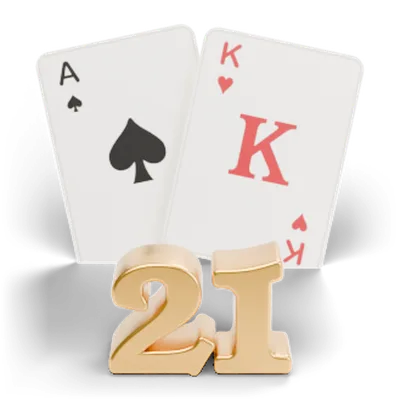
What is Blackjack?
Blackjack, also called 21, is the classic game of you against the dealer. You never play against the others at the table. Each hand is its own contest with the dealer, who follows fixed rules and makes no choices, so the only decisions in the game are yours.
That makes it one of the quickest card games to learn: a single total to watch and a few choices on each turn. At home, one person deals and everyone else plays with chips or counters. The skill is knowing when to take another card, when to stop, and when to double or split.
How to set up
- Pick one person to be the dealer. Everyone else plays against the dealer, betting with chips or coins.
- Shuffle. Everyone bets before the deal.
- Each player gets two cards face up. The dealer gets one up and one hidden.
- The player on the dealer's left goes first, then around the table.
How a turn works
- Add up your cards. Jacks, Queens and Kings count 10, Aces 1 or 11.
- First two cards a pair? You can split them into two hands, with an equal bet on each. Play each on its own.
- On your first two cards, you can double: double your bet for exactly one more card.
- Otherwise hit to take a card, as many as you like, or stand to stop.
- Over 21 is a bust. You lose right away.
How to score and win
- The dealer plays last, hitting until reaching 17 or more, then standing. Some tables also hit a 17 that counts an Ace as 11.
- Beat the dealer's total, or still be in when the dealer busts, and you win what you bet. A tie returns your bet.
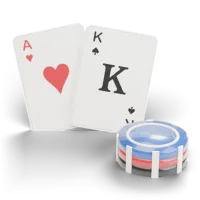
- An Ace with a 10, Jack, Queen or King as your first two cards is blackjack. It usually pays 3 to 2: bet 10, win 15.
- A dealer blackjack beats everything except your own blackjack, which ties.
Watch for
- You play first, so if you bust you lose, even if the dealer busts too.
- If the dealer shows an Ace, you may be offered insurance, a side bet that the dealer has blackjack. Say no: over time it costs you.
- Always split Aces and 8s. Never split 10s.
Learn Blackjack by playing it
A two-minute intro, read aloud, shows how Blackjack is dealt and played. Then play a whole hand with a coach who names every move, and a second one where you make the calls and each gets a grade. 8 short lessons with quizzes cover the rest, and the Basic strategy drill: hit, stand, double, split or surrender, with the reason for each call.
Get Learn to Play Cards, free
Beginner tips
- Watch the dealer's face-up card: against a weak 2 through 6, which busts often, stand on a hard 13 to 16. Against a strong 7 through Ace, hit those totals.
- Always take a card on a hard 11 or less. No single card can push you over 21.
- Soft hands are safe to hit, because the Ace can drop to 1. Hit a soft 17 or less, and stand on a soft 19 or more.
- Check your options in the same order every hand: split first, then double, then hit or stand. That way you never miss a strong move.
House rules and variations
Surrender
Some tables let you give up a hand right after the deal and lose only half your bet. It's the cheaper choice with a hard 16 against a dealer 9, 10 or Ace, and a hard 15 against a 10.
Doubling after a split
Some tables let you double down on a hand you just split, which helps the player a little.
Spanish 21
The number 10s are taken out of every deck, and players get extra bonus hands and looser rules in return.
Pontoon
A British cousin of blackjack where both of the dealer's cards are dealt face down and many of the moves go by different names.
Blackjack questions
How much is an Ace worth in blackjack?
An Ace is worth 1 or 11 in blackjack, whichever helps your hand more. Kings, Queens and Jacks are each worth 10, and every other card counts its number. An Ace with any 10-value card as your first two cards is a blackjack, the best hand in the game.
What does double down mean in blackjack?
Doubling down in blackjack means doubling your bet on your first two cards in exchange for exactly one more card, and then you stop. It's strongest on a hard 11, worth doubling against any dealer card from 2 to 10, because almost one card in three is worth 10.
When should you split in blackjack?
In blackjack, you can split when your first two cards are a pair, making two hands with an equal bet on each. Always split Aces and 8s, and never split 10s or 5s. Other pairs depend on the dealer's face-up card: split 2s, 3s and 7s against a 2 to 7, and 6s against a 2 to 6.
What is a soft 17 in blackjack?
A soft 17 in blackjack is a total of 17 that counts an Ace as 11, such as an Ace and a 6. It's called soft because one more card can't bust it: the Ace just drops to 1. Some tables make the dealer hit a soft 17, which is slightly worse for players.
What is insurance in blackjack?
Insurance in blackjack is a side bet offered when the dealer's face-up card is an Ace. You bet up to half your original bet that the dealer has blackjack, and it pays 2 to 1 if so. The dealer has blackjack less often than insurance needs to break even, so it loses over time.
How do you play blackjack at home?
To play blackjack at home, pick one person to be the dealer and give everyone else chips or counters. Everyone bets, then each player gets two cards face up and the dealer gets one up and one face down. Players hit or stand in turn, and the dealer plays last, hitting until reaching 17 or more.
Words to know
- Blackjack
- An Ace plus a 10-value card (10, J, Q, K) dealt as your first two cards. Also called a 'natural'. Usually pays 3:2.
- Natural
- Another word for blackjack: an Ace plus a 10-value card as your first two cards.
- Bust
- When your hand total exceeds 21, you bust and immediately lose, regardless of what the dealer has.
- Push
- A tie between you and the dealer. Your bet is returned: no win, no loss.
- Soft Hand
- A hand containing an Ace counted as 11. Called 'soft' because hitting can't bust you: the Ace drops to 1 if needed.
- Hard Hand
- A hand without an Ace, or where the Ace must count as 1 to avoid busting. Hitting risks going over 21.
- Pat Hand
- A hand totaling 17-21 that you wouldn't normally hit. It's already strong enough to potentially win.
- Stiff Hand
- A hand totaling 12-16 that risks busting if you hit. The hardest hands to play in blackjack.
- Face Card
- A Jack, Queen, or King. All face cards are worth 10 in blackjack.
- Ten-Value Card
- Any card worth 10: the 10, Jack, Queen, or King. About 31% of all cards are ten-value cards.
- Hand Total
- The sum of all card values in your hand. The Ace counts as 1 or 11, whichever gives a better (non-busting) total.
- Upcard
- The dealer's face-up card that all players can see. Your entire strategy is based on this card.