What is Canasta?
Canasta comes from Uruguay and swept the world in the 1950s. Like other rummy games, it is about collecting matching cards, but partners share their melds and grow them toward seven-card canastas. Jokers and 2s are wild, red 3s are bonus cards, and the whole discard pile can be taken at once, which can swing a hand.
Several rulesets are popular, including Hand and Foot in North America. The rules here follow the standard four-player partnership game. It suits players who like a longer game with a real choice on every turn.
How to set up
- Four players in two teams, partners across the table.
- Deal 11 each. The rest is the stock. Turn one card up to start the discard pile.
- If that card is a wild or a red 3, the pile is frozen: turn another until a normal card appears.
- Lay out any red 3 at once for 100, and draw a replacement.
- The player on the dealer's left goes first. Play goes clockwise.
How a turn works
- Draw the top of the stock, or take the whole discard pile.
- To take the pile, meld its top card at once: with two naturals, a natural and a wild, or on your team's meld.
- Meld if you wish: three or more of a rank, at least two natural (not wild), at most three wild. Black 3s only when going out.
- Your team gets one meld per rank: add to it, don't start another.
- First meld each hand needs 15 with a negative score, 50 from 0, 90 from 1,500, 120 from 3,000. Melds that turn add together.
- Discard one card. A black 3 blocks the pile for a turn, and a wild freezes it.
How to score and win
- Seven cards make a canasta: 500 natural, 300 mixed. Your team needs one before going out.
- To go out, meld your whole hand, with or without a last discard, for 100. That ends the hand. You may ask your partner first.
- Score melded cards, canastas, red 3s and going out, minus cards in both partners' hands. Four red 3s score 800. With no meld, red 3s subtract.
- With no stock, take the pile each turn or the hand ends. Once a team has 5,000 after a hand, the higher score wins.
Watch for
- A frozen pile opens only to two natural cards from your hand. A team that hasn't melded faces the same freeze, plus its first-meld minimum.
- Card values: jokers 50, Aces and 2s 20, 8s through Kings 10, 4s through 7s and black 3s 5.
- Don't spoil a meld that can still become a natural canasta.
- While the pile isn't frozen, never discard a rank the player on your left has melded.
Learn Canasta by playing it
A two-minute intro, read aloud, shows how Canasta is dealt and played. Then play a whole hand with a coach who names every move, and a second one where you make the calls and each gets a grade. 8 short lessons with quizzes cover the rest.
Get Learn to Play Cards, free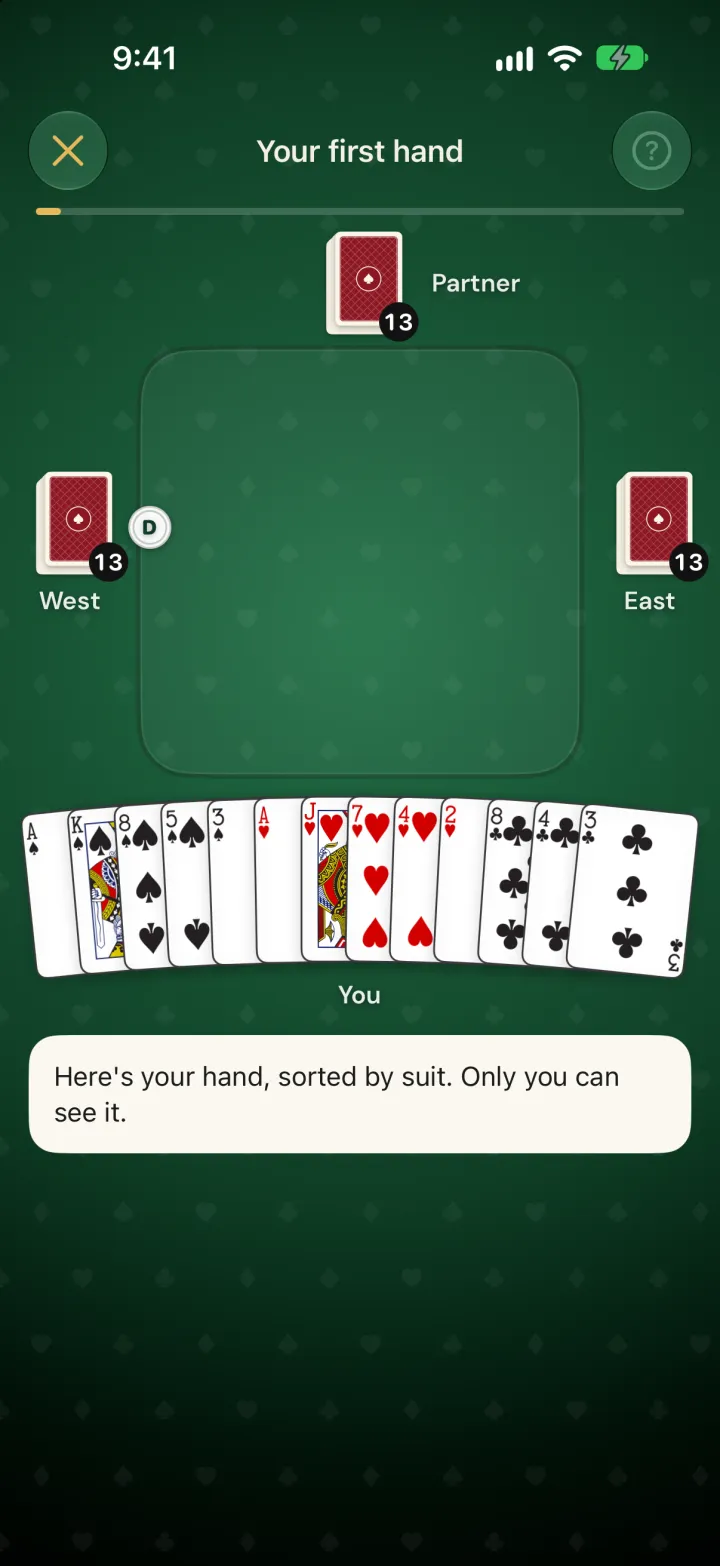
Beginner tips
- Add to your partner's melds before starting your own. One finished canasta is worth far more than two half-built melds.
- Take a big discard pile when you can. Ten or more cards is almost always worth it, but meld quickly so the cards don't count against you.
- Don't hoard wild cards. A joker or 2 still in your hand when the hand ends costs your team 50 or 20 points.
- Before going out, think about your partner's hand. Every card they hold counts against your team, so ask first when they hold many.
House rules and variations
Hand and Foot
Each player has two hands and plays one, then the other, using five or six decks. It is popular in North America.
Samba and Bolivian
These use three decks, allow melds of cards in sequence, and play to 10,000 or 15,000.
Canasta questions
What is a canasta in Canasta?
A canasta is a meld of seven or more cards of the same rank. A natural canasta, with no wild cards, earns a 500-point bonus. A mixed canasta, with at least one joker or 2, earns 300. Your team needs at least one canasta before anyone can go out.
What do red threes do in Canasta?
Red 3s in Canasta are bonus cards, never kept in your hand. When you are dealt or draw one, lay it face up at once and draw a replacement. Each is worth 100 points, and all four together are worth 800. If your team makes no melds that hand, they count against you instead.
What is a frozen pile in Canasta?
A frozen pile in Canasta is a discard pile you can take only with two natural cards, not wild, from your hand that match its top card. Discarding a joker or 2 freezes it, and it stays frozen until someone takes it. The pile is also frozen for a team that hasn't made its first meld.
How many points do you need for your first meld in Canasta?
In Canasta, your team's first meld each hand must reach a minimum set by your score: 15 points with a negative score, 50 from 0, 90 from 1,500 and 120 from 3,000. You can add together every meld you lay down that turn. Later melds have no minimum.
How do you go out in Canasta?
To go out in Canasta, your team must have at least one canasta, and you must meld every card left in your hand, with or without a final discard. Going out ends the hand and scores 100, or 200 if you meld your whole hand in one turn without having melded before. You may ask your partner first.
Can you play Canasta with 2 players?
Yes. In two-player Canasta, each player gets 15 cards, draws two cards a turn, and needs two canastas to go out. Three players can also play, with 13 cards each and everyone for themselves. The standard game is four players in two partnerships.
Words to know
- Meld
- A set of 3 or more cards of the same rank laid face-up on the table. At least 2 cards must be natural (non-wild), and wild cards may supplement the meld. Both partners contribute to and share the same melds. Melds are the primary way to score points in Canasta.
- Canasta
- A meld that has reached 7 or more cards. Completing a canasta is required before a team can go out. The word comes from the Spanish for "basket." Natural canastas (no wilds) earn +500 points; mixed canastas (with wilds) earn +300 points.
- Natural Canasta
- A canasta (7+ cards) composed entirely of natural cards with no wild cards. Also called a "pure" canasta. Earns a +500 point bonus, which is 200 more than a mixed canasta. Traditionally marked by placing a red card on top of the stack.
- Mixed Canasta
- A canasta (7+ cards) that contains at least one wild card (Joker or Two). Earns a +300 point bonus. Once a wild card is added to a natural canasta, it permanently becomes mixed. Traditionally marked by placing a black card on top.
- Wild Card
- Jokers (worth 50 points) and Twos (worth 20 points) that can substitute for any natural rank in a meld. There are 12 wild cards total in the 108-card deck (4 Jokers + 8 Twos). Discarding a wild card freezes the discard pile. Wild cards cannot form their own meld. They only supplement natural cards.
- Frozen Pile
- A discard pile that has been frozen by a wild card (Joker or Two) being discarded onto it. When frozen, the pile can only be taken by holding 2 natural cards matching the top card's rank. Matching to existing melds or using wilds to take it is not allowed. The freeze persists until someone takes the pile. The pile is also frozen against any team that has not yet made its initial meld.
- Red Three
- The 3♥ and 3♦ (four total in the double deck) are special bonus cards worth +100 points each. They must be laid face-up immediately when dealt or drawn, and a replacement card is drawn. If a team has all 4, the bonus is +800. However, if the team never melded, Red Threes become –100 each.
- Black Three
- The 3♣ and 3♠ (four total in the double deck) are blocking cards worth 5 points each. When discarded on the discard pile, they prevent the next player from taking the pile. Black Threes can only be melded when going out, and no wild cards may be included in a Black Three meld.
- Going Out
- Ending the hand by melding all remaining cards from your hand (with an optional final discard). Requires at least one completed canasta for the team. Earns +100 points (or +200 for going out concealed). A player may ask their partner "May I go out?" before melding.
- Initial Meld
- The first meld(s) a partnership lays down in a hand must meet a minimum point value based on the team's cumulative score: 15 points (negative score), 50 points (0–1,499), 90 points (1,500–2,999), or 120 points (3,000+). After the initial meld, subsequent melds have no minimum. Card values in all melds laid that turn count toward the threshold.
- Stock Pile
- The face-down pile of remaining cards in the center of the table after dealing. Players draw one card from the stock at the start of their turn (unless they take the discard pile instead). When the stock runs out, play goes on only while each player takes the last discard. Also called the "draw pile."