What is Cribbage?
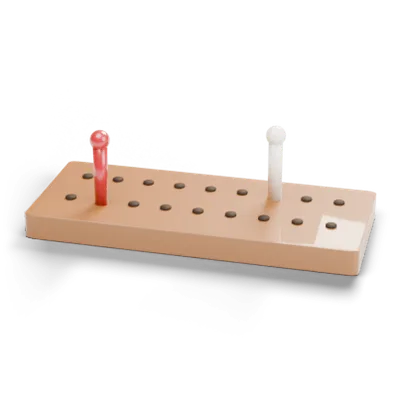
Cribbage dates from the 1600s and is still scored on a wooden board with pegs. Each hand has three parts: choosing what to throw into the crib, pegging points as you lay cards down, and counting what you kept. One card can count in several combinations at once, so quick adding pays off.
It is a two-player game at heart, with versions for three and four. The highest possible hand is 29, which turns up about once in 216,000 hands.
How to set up
- Two players. Cut for deal: each lifts off part of the deck and shows its bottom card. Low card deals first, then you take turns dealing.
- Deal six each. Each player throws two face down to the crib, which scores for the dealer.
- The non-dealer cuts, lifting off part of the deck. The dealer turns over the card underneath: the starter. A Jack pegs the dealer 2.
- An Ace counts 1. A Jack, Queen or King counts 10. Other cards count their number. Queen, King, Ace is not a run.
How a turn works
- The non-dealer leads. Take turns laying one card in front of you and saying the running count, which can't pass 31.
- Exactly 15 or 31 scores 2. Match the card just played: 2, a third 6, a fourth 12. Runs of the latest cards: 1 per card.
- Can't play? Say go. The other player plays on, then whoever played last pegs 1, or 2 at exactly 31.
- Turn the cards over and restart from zero. Whoever didn't play last leads. The very last of the eight pegs 1, unless it made 31.
- Pick your cards back up and score them in order: non-dealer, dealer, then the crib. Each uses four cards plus the starter.
- Score fifteens 2, pairs 2 (three alike 6, four 12), runs 1 per card, flush 4 or 5, holding the Jack of the starter's suit 1.
How to score and win
- First to 121 wins on the spot, even in the middle of playing or scoring a hand.
- Win before the other player reaches 91 and it counts as two games. At 60 or less, three.
Watch for
- Never lead a 5: any 10, Jack, Queen or King makes 15. A 4 is a safe lead.
- Never throw a 5 or a pair into the other player's crib.
- In the crib, a flush needs all five cards.
- A card scores again in each new combination, so count them all.
Learn Cribbage by playing it
A two-minute intro, read aloud, shows how Cribbage is dealt and played. Then play a whole hand with a coach who names every move, and a second one where you make the calls and each gets a grade. 5 short lessons with quizzes cover the rest, and the Count your hand drill: score fifteens, pairs, runs, flushes and nobs yourself, then see the breakdown.
Get Learn to Play Cards, free
Beginner tips
- Before you throw, find the strongest group of cards in your six and keep it together. Then pick the throw that protects it.
- Treat every throw as a trade. A slightly weaker hand that gives your opponent's crib nothing often beats a stronger one that feeds it.
- Lead one card of a pair. If your opponent pairs it, your second card makes three of a kind for 6.
- Near the end, check the board before each hand. The non-dealer counts first and can reach 121 before the dealer's hand and crib are counted.
House rules and variations
Muggins
If a player misses points in their count, the opponent may call muggins and claim them. Agree before play whether it's on.
Three players
Deal five cards each. Each player throws one to the crib, and one card from the deck goes in too.
Four players
Two partnerships, five cards each, and each player throws one card to the crib.
Five-card Cribbage
The original game: deal five cards each, keep three, and play to 61.
Cribbage questions
How does scoring work in Cribbage?
Cribbage scores in two places. During the play, you peg 2 for making the count exactly 15 or 31, 2 for a pair, and 1 per card for a run. In the show, each hand of four cards plus the starter scores 2 per fifteen, 2 per pair, 1 per run card, a flush and 1 for his nobs.
Is Cribbage hard to learn?
Cribbage's rules are short, but counting hands quickly takes practice. Each hand has three steps: throw two cards to the crib, play to 31, then count. The hard part is spotting every fifteen, pair and run. Counting in the same order every time, fifteens, pairs, runs, flush, nobs, helps you miss fewer points.
How do you play Cribbage with 2 players?
Standard Cribbage is a two-player game. Each player gets six cards and throws two face down to the crib, which scores for the dealer. A starter card is turned up, the players take turns laying cards to a count of 31, then each counts their hand. The deal alternates, and the first to 121 wins.
What cards should you put in the crib in Cribbage?
In Cribbage, it depends on whose crib it is. In your own crib, put 5s, 10-value cards, pairs and cards next to each other in rank. In your opponent's crib, put nothing that helps: no 5s, no pairs, and no two cards that touch or add to 15. A King and an Ace is a safe throw.
What are his nobs and his heels in Cribbage?
Both are Jack bonuses in Cribbage. His heels is when the starter card turned up is a Jack, and the dealer pegs 2 at once. His nobs is holding the Jack of the same suit as the starter, in your hand or the crib, worth 1 point when you count.
What is a skunk in Cribbage?
A skunk in Cribbage is winning before your opponent reaches 91 points, and it counts as two games. If they finish with 60 or fewer, it is a double skunk and counts as three. Many boards mark the skunk line at 91.
Words to know
- Cribbage
- A classic card game for 2 players (with variants for 3–4) where the goal is to be the first to reach 121 points. Points are scored through card combinations during play (pegging) and in the hand (the show). Uniquely tracked on a wooden board with pegs.
- Crib
- An extra hand of 4 cards formed by each player discarding 2 cards face-down before play begins. The crib belongs to the dealer and is scored after both players count their regular hands. Also called the 'box.'
- Pegging
- The phase of Cribbage where players alternate playing cards from their hands, keeping a running count up to 31. Points are scored for reaching 15 or 31, making pairs, and completing runs. Also refers to the act of moving pegs on the cribbage board to track score.
- Starter
- The card cut from the stock and placed face-up after both players discard to the crib. The starter is shared by all hands (both players and the crib) when counting during the show. If the starter is a Jack, the dealer scores 2 points for 'His Heels.' Also called the 'cut card' or 'turn-up.'
- Fifteens
- Any combination of cards whose values total exactly 15, scoring 2 points each. During counting, every unique combination counts separately, and cards can be reused across different combinations. During pegging, reaching a running total of exactly 15 also scores 2 points.
- Nobs
- Holding the Jack of the same suit as the starter card, scoring 1 point. Announced as 'one for his nobs' during the show. Not to be confused with 'His Heels,' which is when the starter itself is a Jack (scoring 2 points for the dealer).
- Heels
- When the starter card (cut card) is a Jack, the dealer immediately scores 2 points. This is called 'His Heels' and is pegged right away, before the play phase begins. It's a small but sometimes crucial bonus for the dealer.
- Go
- Declared when a player cannot play a card without the running count exceeding 31 during pegging. After a Go, the opponent continues playing until they also cannot play. The last player to play a card scores 1 point for Go (or 2 if hitting exactly 31). The count then resets to 0.
- Skunk
- A decisive victory where the winner reaches 121 before the loser reaches 91, so the loser finishes with 61 to 90 points. A skunk typically counts as 2 games. A double skunk, where the loser has 60 or fewer, counts as 3 games.
- Muggins
- An optional rule where if a player miscounts their hand and misses points, the opponent can call 'Muggins!' and claim those missed points for themselves. Encourages careful and accurate counting. In ACC tournaments it applies only when announced before play begins.