What is Go Fish?
Go Fish is often the first card game children learn. There is nothing to add up and no special cards to remember. If you can tell a 7 from a King, you can play. It belongs to the same family as Authors and Happy Families, collecting games played for well over a century, and children in French-speaking Canada call it "draw from the lake."
It looks like luck, but it rewards listening. You may only ask for a rank you already hold, so every question at the table tells you something about the asker's hand. That one rule turns a simple family game into a quiet memory contest, which is why older kids and adults still enjoy it.
How to set up
- Pick a dealer and shuffle. Deal one card at a time: 7 each with 2 or 3 players, 5 each with 4 to 6.
- Put the rest face down in the middle: the stock, or pond.
- Keep your hand hidden. The player on the dealer's left goes first, and play moves clockwise.
How a turn works
- Pick any player and ask for a rank you already hold.
- If they have it, they give you every card of it, and you ask again.
- If they don't, they say "Go fish." Draw one card. Your turn ends, unless it's the rank you asked for: show it and go again.
- Four of a rank is a book, however you got it. Lay it face up right away. If it came from an ask, keep asking.
- Hand empty on your turn? Draw one card and ask for that rank. No stock left? You're done.
How to score and win
- Once the stock is gone, "Go fish" just ends the turn, with no draw.
- The game ends when all 13 books are made.
- Each book is one point, and the most books wins. Seven books can't be beaten.
- Tied? Call it a draw, or play another hand to settle it.
Watch for
- You can't ask for a rank you don't hold.
- When asked, give every card of that rank, not just one.
- Listen to every ask: the asker must hold that rank.
- Some groups score pairs instead of books, or stop when the stock runs out. Agree before you deal.
Learn Go Fish by playing it
A two-minute intro, read aloud, shows how Go Fish is dealt and played. Then play a whole hand with a coach who names every move, and a second one where you make the calls and each gets a grade. 4 short lessons with quizzes cover the rest.
Get Learn to Play Cards, free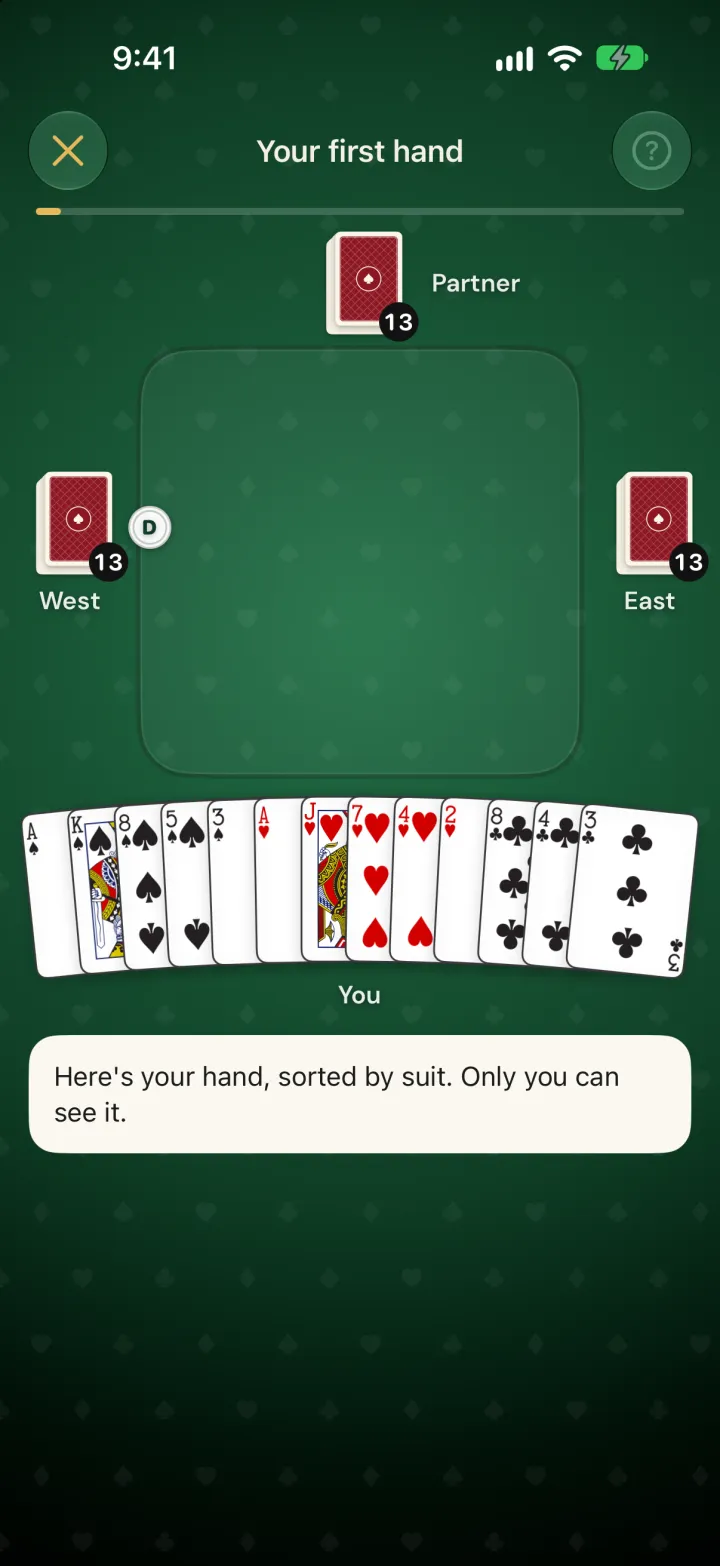
Beginner tips
- If someone just asked for a rank you also hold, ask them for it next. You know they have it, and a successful ask keeps your turn going.
- Holding three of a rank? Go after the fourth before anything else, since one card finishes the book.
- With no clues to go on, ask the player holding the most cards. A big hand is the most likely to have what you need.
- Treat a "Go fish" as fresh news only. Once that player draws or receives cards, they may hold the rank after all.
House rules and variations
Pairs instead of books
Score a point for every pair, two cards of the same rank, instead of a book of four. There are 26 pairs to make, so the game is quicker and easier for children under six.
Strict fishing
Any card you fish ends your turn, even the rank you just asked for.
Ask for an exact card
Ask for one card, like "the King of Hearts," instead of any Kings. It's harder to guess right, but it gives away less about your hand.
Stop when the stock runs out
Some groups end the game as soon as the stock is empty, or when one player runs out of cards, and count books then.
Go Fish questions
How do you play Go Fish?
In Go Fish, you take turns asking another player for a rank you already hold, like "Any Kings?" If they have any, they give you every one and you ask again. If not, they say "Go fish" and you draw one card. Four cards of one rank make a book, and the most books wins.
How many cards do you get in Go Fish?
In Go Fish, each player gets 7 cards with 2 or 3 players, and 5 cards with 4, 5 or 6 players. Deal one card at a time. The rest go face down in the middle as the stock, or pond, to draw from. Some families deal 5 or 6 to everyone instead.
What is a book in Go Fish?
A book in Go Fish is all four cards of one rank, such as four 7s or four Queens. Suits don't matter. Lay a book face up as soon as you have it, whether it came from an ask, a draw or the deal. Each book is one point, and seven books can't be beaten.
What happens when you run out of cards in Go Fish?
If your hand is empty on your turn in Go Fish, draw one card from the stock and ask for that rank. If the stock is empty too, you're done for the game, and your books still count. Once the stock is gone, "Go fish" simply ends the turn with no draw.
Can you ask for a card you don't have in Go Fish?
No. In Go Fish you may only ask for a rank you already hold at least one of. That rule is why every ask is a clue: when someone asks for 8s, you know they have an 8. If a young child asks for a rank they don't hold, remind them gently and let them ask again.
Do you go again if you fish the card you asked for in Go Fish?
Yes. In Go Fish, if the card you draw is the rank you just asked for, show it and take another turn. Any other card ends your turn. Some families play that every fished card ends the turn, so agree on it before you deal.
Words to know
- Book
- A complete set of four cards of the same rank. For example, all four Queens (Q♥ Q♦ Q♣ Q♠) form one book. Books are the scoring unit in standard Go Fish.
- Rank
- The number or face value of a card, ignoring its suit. The 13 ranks are: 2, 3, 4, 5, 6, 7, 8, 9, 10, Jack, Queen, King, and Ace. In Go Fish, you ask for cards by rank.
- Stock (Fish Pond)
- The face-down pile of undealt cards in the center of the table. When someone says 'Go fish!' you draw the top card from the stock. Also called the pool or fish pond.
- Go Fish
- The response given when you don't have any cards of the rank someone asked for. The asker must then draw one card from the stock. Also the name of the game itself!
- Hand
- The cards you're currently holding, kept hidden from other players. Your hand changes as you receive cards, give cards away, draw from the stock, and lay down books.
- Dealer
- The player who shuffles and distributes cards at the start of the game. The player to the dealer's left typically goes first, and turns proceed clockwise.
- Pair (Variant)
- In a common Go Fish variant, two cards of the same rank count as a scoring set instead of requiring all four. This makes games faster and is popular with young children.
- Void (Strategy)
- Having zero cards of a particular rank. When you know a player is void in a rank (because they said 'Go fish'), you should avoid asking them for that rank unless they've drawn new cards since.