What is Seven-Card Stud?
Seven-Card Stud was the main poker game in American card rooms for decades, before Texas Hold'em took over. There are no shared cards in the middle. Instead, four of each player's seven cards are dealt face up, so the whole table sees part of every hand, and remembering what has been shown is a big part of the skill.
It suits players who like a patient game of memory and reading the table. Bets usually come in two fixed sizes, which keeps the betting simple. It plays with two to eight people and is best with five to seven.
How to set up
- Agree on the bets. In a 2/4 game: a half-point ante, a 1-point bring-in, 2-point bets for two rounds, then 4.
- Everyone puts in a small ante before the deal.
- Deal each player two cards face down and one face up, the door card.
How a turn works
- Third Street: the lowest door card pays the bring-in, a small forced bet. Betting goes clockwise. Anyone may complete: turn it into a full bet.
- Fourth Street: one more card up. From here on, the best hand showing acts first each round and may check (bet nothing) or bet.
- Fifth and Sixth Street: one more card up each. Bets are now the big bet.
- Seventh Street: the last card comes face down, then one last round of big bets.
- When it's your turn to answer a bet: call to match it, raise to add one more bet on top, or fold to give up.
- A round ends when everyone still in has acted and put in the same amount. Then the next card comes, or the showdown.
How to score and win
- Make your best five-card hand from your seven cards.
- The last player to bet or raise shows first. The best hand takes the pot.
- If everyone else folds, you win the pot without showing your cards.
- Best first: straight flush, four of a kind, full house, flush (one suit), straight (in a row), three of a kind, two pair, pair, high card.
Watch for
- Playing too many hands. Most starting hands should be folded.
- Forgetting folded cards. A card you've seen is one nobody can deal you.
- Tied door cards: suits break the tie, lowest first: clubs, diamonds, hearts, spades.
- A pair showing on Fourth Street lets anyone bet the big amount.
Poker hand rankings
From best to worst. Suits never rank: two flushes compare their highest cards.
| # | Hand | Example |
|---|---|---|
| 1 | Royal flush A K Q J 10, all one suit | A♠ K♠ Q♠ J♠ 10♠ |
| 2 | Straight flush Five in a row, all one suit | 9♥ 8♥ 7♥ 6♥ 5♥ |
| 3 | Four of a kind Four cards of one rank | Q♣ Q♦ Q♥ Q♠ 4♦ |
| 4 | Full house Three of a kind plus a pair | 8♠ 8♥ 8♦ K♣ K♥ |
| 5 | Flush Any five of one suit | A♦ J♦ 8♦ 6♦ 2♦ |
| 6 | Straight Five in a row, mixed suits | 10♣ 9♦ 8♠ 7♥ 6♣ |
| 7 | Three of a kind Three cards of one rank | 7♣ 7♦ 7♠ K♥ 2♠ |
| 8 | Two pair Two different pairs | J♥ J♣ 4♠ 4♦ A♣ |
| 9 | Pair Two cards of one rank | 10♠ 10♥ K♦ 6♣ 3♠ |
| 10 | High card None of the above: highest card plays | A♣ Q♦ 9♠ 6♥ 3♣ |
Learn Seven-Card Stud by playing it
A two-minute intro, read aloud, shows how Seven-Card Stud is dealt and played. Then play a whole hand with a coach who names every move, and a second one where you make the calls and each gets a grade. 5 short lessons with quizzes cover the rest.
Get Learn to Play Cards, free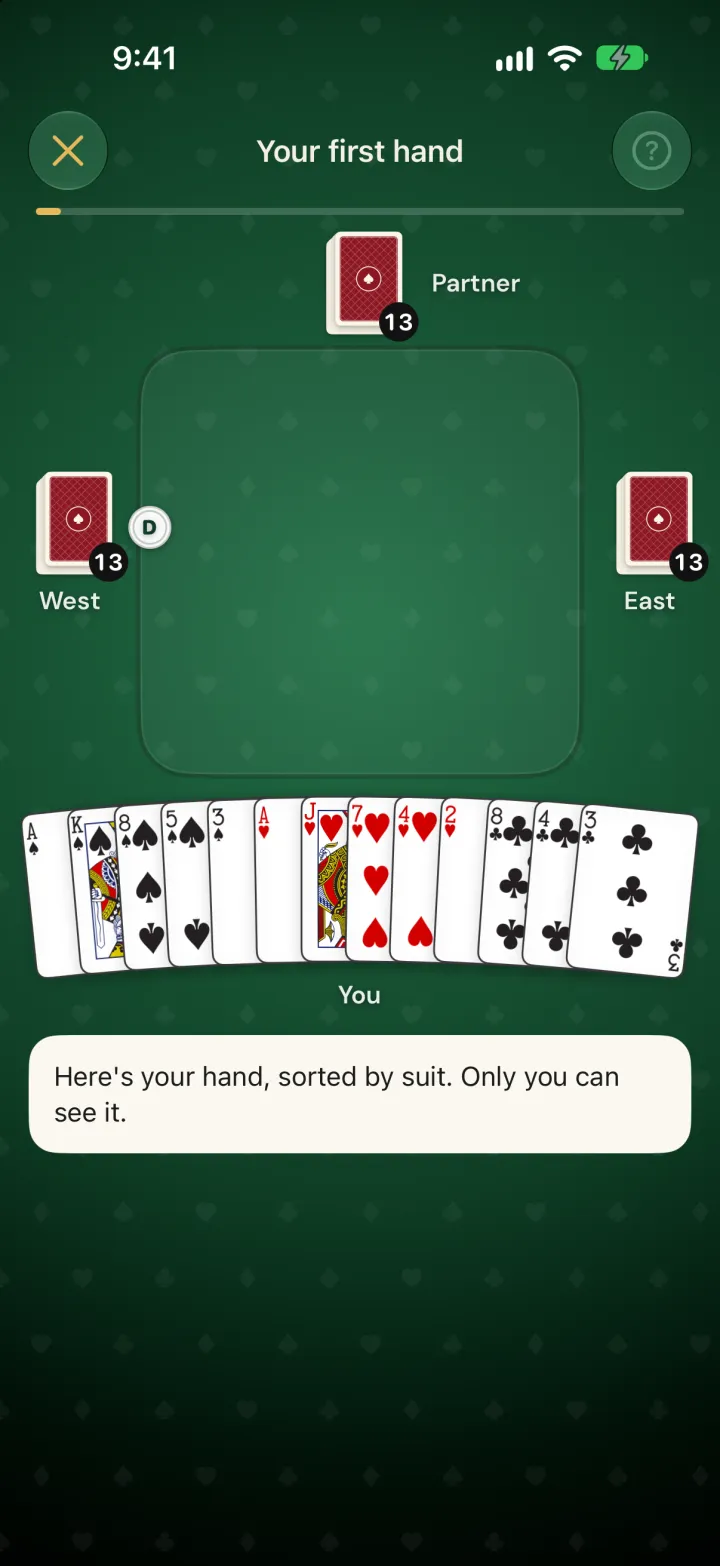
Beginner tips
- A pair hidden in your two face-down cards is worth more than a pair with one card showing. When half your pair is face up, the table can see what you're building.
- Fifth Street, when the bets double, is the big decision. A hand that calls there usually ends up calling twice more, so let a small pair that hasn't improved go.
- Before chasing a flush or a straight, count how many of the cards you need already show in other hands. The cards still unseen are your live cards, and fewer live cards means more reason to fold.
- Notice who turns the bring-in into a full bet from a high door card. It may be a strong hand, or a steal: a bet hoping to win the antes with nothing.
House rules and variations
Stud Hi-Lo, eight or better
The pot splits between the best high hand and the best low hand, which must be five different ranks, all 8 or lower, with Aces low. If nobody has a low hand, the high hand takes it all.
Razz
The lowest hand wins, Aces count low, and straights and flushes don't count against you. The highest door card pays the bring-in instead of the lowest.
Five-Card Stud
An older, simpler cousin with one card face down and four face up, and no final face-down card.
Seven-Card Stud questions
How do you play Seven-Card Stud?
In Seven-Card Stud, everyone puts in a small ante, then gets two cards face down and one face up. The lowest face-up card makes a small forced bet called the bring-in. Three more cards come face up and a last one face down, with betting after each. The best five-card hand from your seven wins the pot.
How many cards do you get in Seven-Card Stud?
You get seven cards in Seven-Card Stud: three face down that only you see and four face up for the whole table. You use the best five. If eight players all stay in to the end, there aren't enough cards, so the last card goes face up in the middle and everyone shares it.
What is the bring-in in Seven-Card Stud?
The bring-in is a small forced bet on the first round of Seven-Card Stud, paid by the player whose face-up card, the door card, is lowest. It's smaller than a full bet, and players may complete it to a full bet. If two door cards tie, the lower suit pays: clubs, then diamonds, hearts and spades.
How many betting rounds are there in Seven-Card Stud?
Seven-Card Stud has five betting rounds, one after each card from the third to the seventh, called Third Street through Seventh Street. The first two rounds use the small bet and the last three use the big bet, usually twice as much. In a 2/4 game, that's 2 points, then 4.
Who goes first in Seven-Card Stud?
On the first round of Seven-Card Stud, the player with the lowest face-up card goes first by paying the bring-in. From the fourth card on, the player whose face-up cards make the best poker hand acts first, and may check, which means bet nothing, or bet. The first player can change every round.
What is the difference between Seven-Card Stud and Texas Hold'em?
The biggest difference is that Seven-Card Stud has no shared cards. Each player gets seven cards of their own, four of them face up, while Hold'em gives you two private cards and five shared ones. Stud also uses an ante and a bring-in instead of blinds, usually has fixed bet sizes, and has five betting rounds, not four.
Words to know
- Seven-Card Stud
- A classic poker variant for 2–8 players where each player receives 7 individual cards (2 face-down, 4 face-up, 1 final face-down) over 5 betting rounds. There are no community cards. Players make the best 5-card poker hand from their 7 cards. It was the most popular poker game in the United States before the rise of Texas Hold'em.
- Third Street
- The first betting round in Seven-Card Stud, occurring after each player has received 3 cards (2 face-down hole cards and 1 face-up door card). The player with the lowest-ranking door card posts the bring-in to start the action. Called "Third Street" because each player has 3 cards.
- Fourth Street
- The second betting round in Seven-Card Stud. Each remaining player receives a second face-up card. The player showing the highest-ranking upcards acts first. Betting uses the small-bet amount unless an open pair is showing, in which case the big-bet amount is optionally allowed.
- Fifth Street
- The third betting round in Seven-Card Stud. Each remaining player receives a third face-up card (5 total cards: 2 down, 3 up). The big-bet amount kicks in from this street forward, doubling the cost of bets and raises. Often considered the key decision point in the hand.
- Bring-In
- A forced bet on Third Street posted by the player showing the lowest-ranking door card. The bring-in is smaller than a full bet (typically half the small-bet amount or less). If two players tie for the lowest rank, the suit determines who pays (clubs is lowest). The bring-in player may optionally "complete" to a full small bet.
- Ante
- A small forced bet that every player must post before cards are dealt. The ante seeds the pot and ensures there is something to compete for each hand. In a typical game, the ante is a small fraction of the lower bet limit (e.g., 0.50 points in a 2/4-point game). All antes go into the pot before dealing begins.
- Upcard
- Any card dealt face-up to a player, visible to all opponents at the table. In Seven-Card Stud, each player receives 4 upcards over the course of the hand (one on Third Street and one each on Fourth, Fifth, and Sixth Street). Upcards provide critical information for reading opponents’ hands and tracking dead cards.
- Hole Card
- A card dealt face-down to a player, visible only to that player. In Seven-Card Stud, each player receives 3 hole cards total: 2 on Third Street and 1 final hole card on Seventh Street. Hole cards are the source of hidden information and deception in Stud poker.
- Door Card
- A player’s first face-up card, dealt on Third Street. The door card is the first piece of public information about a player’s hand. The lowest door card determines which player posts the bring-in. Also called the "third street card" or simply "the up card" on Third Street.
- Rolled-Up
- Three of a kind dealt on Third Street: two matching hole cards plus a matching door card. This is the strongest possible starting hand in Seven-Card Stud. The probability of being dealt rolled-up trips is approximately 0.24% (about 1 in 425 deals). Also called "rolled-up trips" or "wired trips."