What is Bridge?
Bridge is the great partnership game. You and your partner can't show each other your cards or talk about them, so the auction is how you share what you hold, one bid at a time. Once the bidding ends, the winning bidder's partner lays their cards face up, and the winning bidder plays both hands.
It suits people who enjoy planning and teamwork, and it rewards practice. Clubs and tournaments play duplicate Bridge, where every table plays the same deals, while home games often play four hands and add up the scores.
How to set up
- Four players. Partners sit across from each other: you and your partner against the other two.
- Deal all 52 cards one at a time, clockwise, 13 each. The deal moves left after each hand.
- Sort by suit, then count your points: Ace 4, King 3, Queen 2, Jack 1.
- Open with about 12 points, and five cards to open hearts or spades. Answer partner with about 6. Aim for 25 between you for game.
How a turn works
- Auction: from the dealer, each player bids or passes. A bid is a number plus a suit or No Trump. Skip doubling, which raises the stakes.
- Each bid must beat the last: a higher number, or the same number in a higher suit. Clubs, diamonds, hearts, spades, No Trump.
- After a bid, three passes end it: the last bid is the contract. Add six for your tricks. If all four pass, deal again.
- The first player on the winning side to name that suit is declarer. The player on declarer's left leads.
- Dummy, declarer's partner, then lays all their cards face up, and declarer plays both hands.
- Follow suit if you can. The highest trump wins, or else the highest card of the suit led. The winner leads next.
How to score and win
- Each number in your bid scores 20 in clubs and diamonds, 30 in hearts and spades. No Trump is 40, then 30 each.
- A contract worth 100 or more is game: a 300 bonus, or 500 when vulnerable. Anything less earns a bonus of 50.
- Fall short, and you score nothing. The other side scores 50 for each trick you missed, or 100 when you're vulnerable.
- Play four hands. Nobody is vulnerable on the first, the dealer's side on the second and third, everyone on the fourth. Highest total wins.
Watch for
- Check your hand before playing another suit. Failing to follow when you could is a revoke, and it costs tricks.
- Count trumps. When the other side has none left, stop leading them.
- Spades outrank hearts only in the bidding. During play, only trump matters.
- Only the number you bid counts toward game. If you can take ten, bid 4 Spades, not 3. Extra tricks score their usual value.
Learn Bridge by playing it
A two-minute intro, read aloud, shows how Bridge is dealt and played. Then play a whole hand with a coach who names every move, and a second one where you make the calls and each gets a grade. 10 short lessons with quizzes cover the rest.
Get Learn to Play Cards, free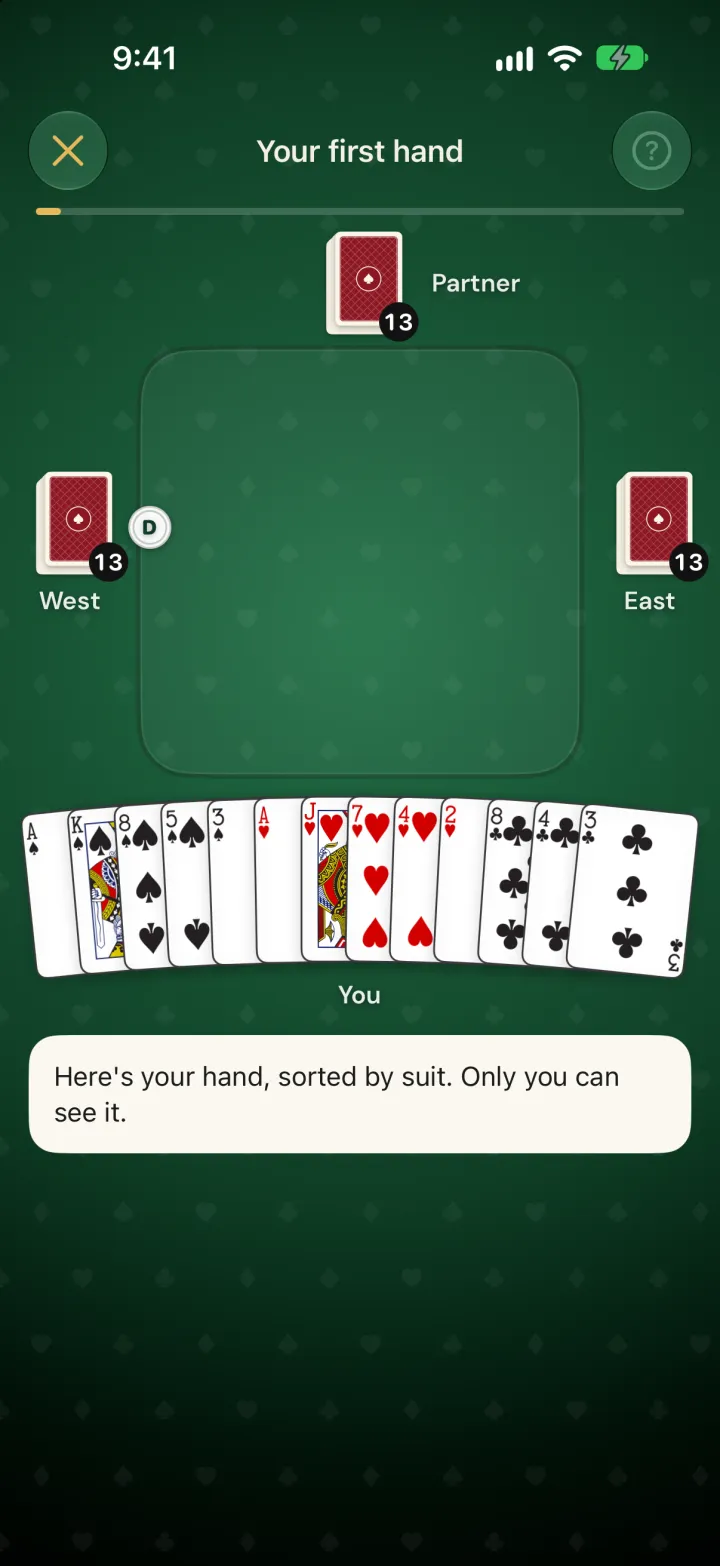
Beginner tips
- Look for eight cards of one suit between you and your partner, especially hearts or spades. If partner bids hearts or spades and you hold three or more, support it by bidding that suit higher.
- As declarer, plan before you play to the first trick. In No Trump count your sure winners, and with a trump suit count your losers and decide how to get rid of them.
- On defense, lead the top card of two touching high cards, like the King from King and Queen. Against No Trump, lead the fourth-highest card of your longest suit.
- When partner leads and you can't win the trick, play a high card you can spare, like a 9, to say keep going in this suit, or a low one like a 2 to ask for a switch.
House rules and variations
Doubling
Standard rules let a player double the other side's bid, which doubles both the reward for making it and the penalty for failing. The bidders can then redouble.
Rubber Bridge
The classic home format. Smaller scores add up across hands until a side reaches 100 for a game, and the first side to win two games takes the rubber and a bonus.
Duplicate Bridge
Every table plays the same deals, and your score is compared with others who held the same cards, so the luck of the deal matters less.
Minibridge
A version for beginners with no auction. Players announce their points instead of bidding.
Bridge questions
How do you play Bridge?
In Bridge, four players in two partnerships are each dealt 13 cards. An auction sets the contract: how many tricks one side promises and which suit is trump. The winning bidder's partner, the dummy, lays their cards face up, and 13 tricks are played. If the bidders take enough tricks they score. If not, the other side does.
How does bidding work in Bridge?
In Bridge, each bid is a number from 1 to 7 plus a suit or No Trump. Add six to the number for the tricks you promise, so 3 Hearts means nine tricks with hearts as trump. Each bid must beat the last, in the order clubs, diamonds, hearts, spades, No Trump. Three passes in a row end the auction.
What is the dummy in Bridge?
The dummy in Bridge is the partner of the declarer, the player who plays the contract. After the first card is led, the dummy lays all 13 cards face up on the table and takes no further part. The declarer then plays both hands, their own and the dummy's.
How many points do you need to open in Bridge?
You usually need about 12 high-card points to open the bidding in Bridge, counting Ace 4, King 3, Queen 2 and Jack 1. To open in hearts or spades you also want at least five cards in that suit. Partner needs about 6 points to answer, and 25 between you is the usual target for game.
How does scoring work in Bridge?
In Bridge you score only for tricks you bid and make: 20 each in clubs or diamonds, 30 in hearts or spades, and in No Trump 40 for the first, then 30. A contract worth 100 or more is game, with a 300 bonus. Anything less earns 50. Fall short, and the other side scores 50 a trick.
What does vulnerable mean in Bridge?
Vulnerable in Bridge means a side's bonuses and penalties are bigger on that hand. A vulnerable game earns 500 instead of 300, but each trick you fall short costs 100 instead of 50. Over four hands, nobody is vulnerable on the first, the dealer's side on the second and third, and everyone on the fourth.
Words to know
- Trick
- A round of play where each of the four players contributes one card. The highest card (following suit and trump rules) wins the trick. There are exactly 13 tricks in every hand of Bridge.
- Trump
- The suit designated during the auction as having special power. Any card of the trump suit beats any card of a non-trump suit, regardless of rank. The trump suit is determined by the final contract. In a No Trump contract, there is no trump suit.
- Declarer
- The player who plays both their own hand and the dummy's hand during the play phase. The declarer is the first player on the winning side who bid the strain (suit or No Trump) of the final contract.
- Dummy
- The declarer's partner. After the opening lead, the dummy lays their entire hand face-up on the table, and the declarer plays the cards from both hands. The dummy may not suggest plays or participate in decisions.
- Auction
- The bidding phase that occurs before the play of cards. Players take turns making bids, passing, doubling, or redoubling. The auction determines the contract (trump suit and number of tricks required). It ends after three consecutive passes following a bid.
- Contract
- The final bid in the auction, which establishes the trump suit (or No Trump) and the number of tricks the declaring side must win. For example, a contract of 4♠ means the declaring side must win at least 10 tricks with spades as trump.
- No Trump (NT)
- A contract with no trump suit. In No Trump, the highest card in the suit led wins each trick, and off-suit cards cannot trump in.
- Three No Trump (3NT)
- A contract requiring 9 total tricks with no trump suit. It is the lowest-level game contract in Bridge and the most common game target.
- Left-Hand Opponent (LHO)
- The opponent seated to your left. In Bridge notation and discussion, this player is abbreviated LHO.
- Right-Hand Opponent (RHO)
- The opponent seated to your right. In Bridge notation and discussion, this player is abbreviated RHO.
- Vulnerability
- A condition affecting scoring. When vulnerable, bonuses for making game and slam are larger, but penalties for failing are also harsher. In rubber Bridge, vulnerability is earned by winning a game. In duplicate Bridge, it follows a fixed rotation.
- Game
- A scoring milestone of 100 or more trick points. In duplicate Bridge it must come from a single contract, and making game earns a bonus of 300 not vulnerable or 500 vulnerable. In rubber Bridge, part-scores from earlier hands add up toward game, and two games win the rubber. The minimum game contracts are 3NT (100 points), 4♥/4♠ (120 points), or 5♣/5♦ (100 points).