
What is Spades?
Spades is a partnership game. You and the player across the table share one bid and one score, but you can't discuss your cards. The bid is what sets it apart: before a card is played, each player predicts how many tricks they will take, and your team is judged on making that number, not on winning the most.
Rules vary by region and league. The rules here follow a common American partnership format, with nil bids and a 100-point penalty for ten bags. It suits four players who enjoy teamwork, careful counting and a little risk.
How to set up
- Four players in two teams. Partners sit across from each other.
- Anyone can deal first. Deal all 52 cards, 13 to each player. The deal moves one seat clockwise each hand.
- Starting left of the dealer, each player bids the tricks they expect to win: at least 1, or nil.
- Optional nil bid: promise to win no tricks. Succeed for 100 points. Win even one and lose 100. Those tricks count only as bags.
- Add each pair's bids to get that team's contract, and write both down.
How a turn works
- The player left of the dealer leads the first trick. After that, each trick's winner leads.
- Going clockwise, everyone plays one card. You must follow the suit that was led if you can.
- With none of that suit, play any card, including a spade to trump the trick.
- The highest spade wins. With no spade played, the highest card of the suit led wins. Ace is high, 2 is low.
- You can't lead a spade until one has been played on another suit, unless you hold only spades.
How to score and win
- After 13 tricks, count. Make your contract: 10 points per trick bid, plus 1 for each extra trick, called a bag.
- Miss your contract: minus 10 per trick bid. The tricks you won count for nothing.
- Bags carry over from hand to hand. Reaching ten costs your team 100 points and takes ten off the count.
- The first team to 500 points wins. If both reach it on the same hand, the higher score wins.
Watch for
- Your contract is shared. Unless one of you bid nil, it doesn't matter which partner wins the tricks.
- Don't trump a trick your partner is already winning.
- Kings without the Ace aren't sure tricks. When unsure, round your bid down.
- No talking about your cards. Your bid and your plays are your only signals.
Learn Spades by playing it
A two-minute intro, read aloud, shows how Spades is dealt and played. Then play a whole hand with a coach who names every move, and a second one where you make the calls and each gets a grade. 8 short lessons with quizzes cover the rest, and the Follow the rules drill: tap a card you're allowed to play as tricky spots come up.
Get Learn to Play Cards, free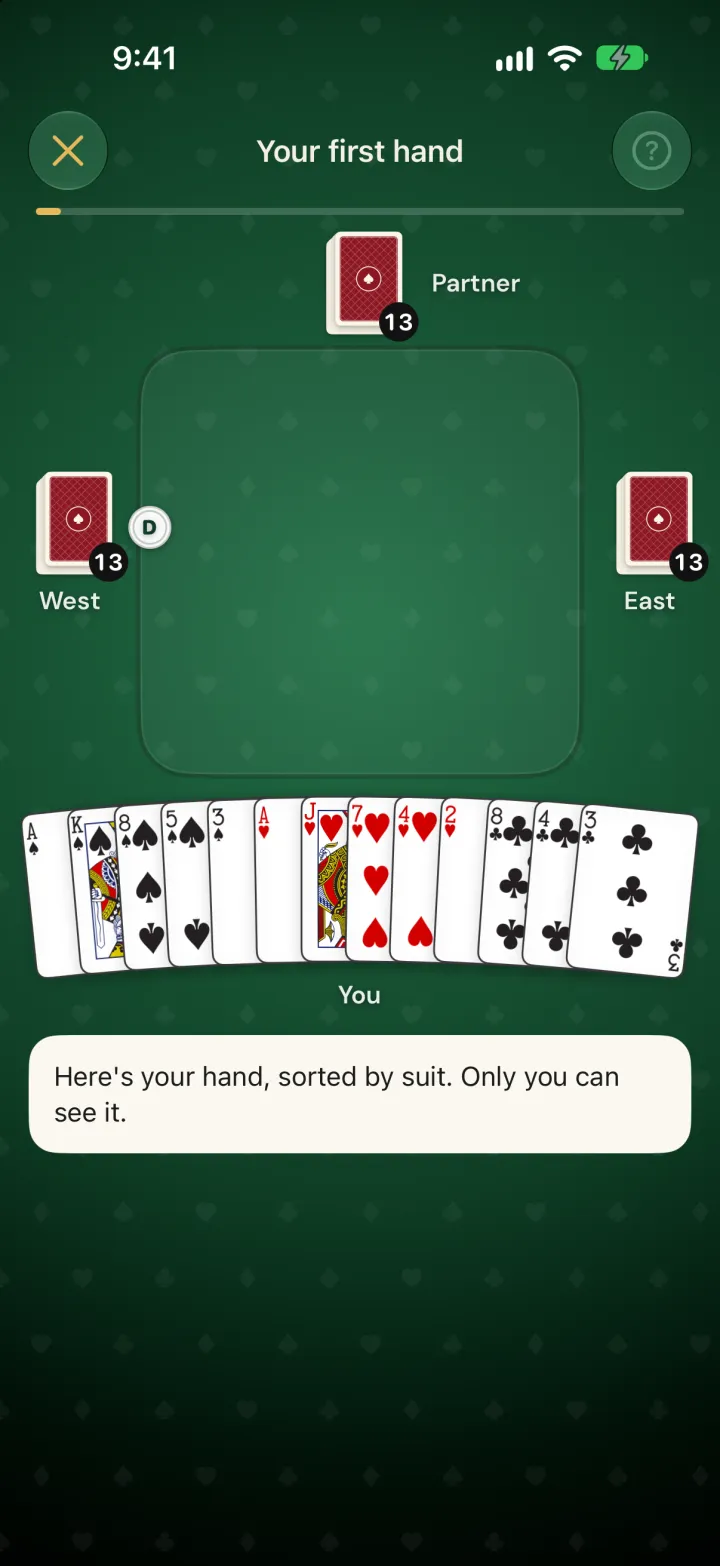
Beginner tips
- Count your bid in steps: sure tricks like the Ace of Spades and other Aces first, then likely ones. Add one for five or more spades and one for a missing suit, since you can trump it.
- With five or more spades, lead your high spades once they are allowed. Pulling out the other players' spades makes your Aces and Kings in other suits safe.
- Once your bid is made, play low and let others win tricks, unless taking one would set the other team. At 8 or 9 bags, duck everything.
- Add up all four bids. A total far above 13 means someone will miss, and far below means bags are coming.
House rules and variations
Blind nil
Bid nil before looking at your cards, for 200 points or minus 200. Many groups allow it only when a team trails by 100 or more.
10 for 200
A team that bids 10 tricks between them scores 200 for taking exactly 10, and loses 200 otherwise.
Jokers
Two jokers become the highest trumps, above the Ace of Spades, and two low cards are taken out.
No breaking rule
Some groups let anyone lead spades at any time. Check before the first hand.
Spades questions
How do you play Spades with partners?
In Spades, partners sit across from each other and add their two bids together to make the team's contract, the number of tricks it must win. It doesn't matter which partner wins them. You can't talk about your cards, so your partner learns about your hand only from your bid and the cards you play.
Can you play Spades with 2 people?
Yes, but Spades is built for four players in two teams, so two-player versions change how hands are made. Each player gets extra cards, dealt or drawn from the deck. Several formats exist, so agree on one before you start. Three players can play cutthroat Spades, with no partners.
What happens if you don't make your bid in Spades?
If your team misses its bid in Spades, it loses 10 points for every trick it bid, and the tricks it did win score nothing. This is called being set. Bid 6 and take 5, and your team scores minus 60. A missed bid costs far more than one extra trick.
What is a nil bid in Spades?
A nil bid in Spades is a promise to win no tricks at all. Make it and your team scores 100. Win even one trick and your team loses 100, and those tricks count only as bags. Your partner bids and plays normally. A blind nil, bid before looking at your cards, is worth 200 either way.
What are bags in Spades?
Bags, or sandbags, are tricks your team wins beyond its bid in Spades. Each one adds 1 point, but bags carry over from hand to hand, and reaching ten costs your team 100 points. That is why players often play low on purpose once their bid is made.
What card do you play first in Spades?
In Spades, the player to the dealer's left leads the first trick with any card except a spade. Spades can't be led until one has been played on another suit, unless your hand holds only spades. An Ace of hearts, clubs or diamonds is a common first lead, because it is a sure trick.
Words to know
- Trump
- A suit that beats all other suits. In Spades, spades are always trump: any spade beats any card of another suit, regardless of rank.
- Bid
- Your prediction of how many tricks you will win. Your bid plus your partner's bid becomes your team's contract. Accurate bidding is the most important skill in Spades.
- Contract
- The total number of tricks your team must win, calculated by adding both partners' bids together. Making your contract earns +10 per trick bid.
- Bags
- Tricks won beyond your contract (overtricks). Each bag is worth +1 point, but every 10 accumulated bags triggers a −100 point penalty. Bags carry over between hands.
- Nil Bid
- A special bid of zero tricks. If you win no tricks, your team earns +100 points. If you fail (win even 1 trick), your team loses −100 points. High risk, high reward.
- Blind Nil
- Bidding nil before looking at your cards. Worth +200 if successful, −200 if failed. Often restricted to when your team is behind by 100+ points. A desperate gamble.
- Partnership
- You and your partner (sitting across from you) play as a team. Your bids combine into a contract, your scores are shared, and you work together to make your bid.
- Set
- Failing to make your team's contract. Getting set costs −10 points per trick bid. Also called 'going set.'
- Cover
- Playing a high card to win a trick that your partner (especially a nil bidder) might otherwise be forced to take. Covering protects your partner.
- Breaking Spades
- The first time a spade is played in a hand (usually because someone was void in the led suit). Before spades are broken, no one may lead a spade unless they hold only spades. Once broken, spades may be led freely.
- Renege
- An illegal play where a player fails to follow suit when they have a card of the led suit. Also called a revoke. Penalties vary but are typically severe in competitive play.
- Trick
- One round of play where each player contributes one card. The highest card of the led suit wins, unless a spade (trump) is played. Then the highest spade wins. There are 13 tricks per hand.